
How to Search Denver County Criminal Records
Denver splits criminal records across three official systems. The Denver County Court public portal covers misdemeanors, municipal offenses, traffic crimes, and the felony advisement stage. The Colorado Judicial docket search covers District Court felonies and Juvenile cases. The CBI Internet Criminal History Check holds the statewide fingerprint-based arrest history.
The CBI portal at the link above is the gateway for a state-level Colorado record search. 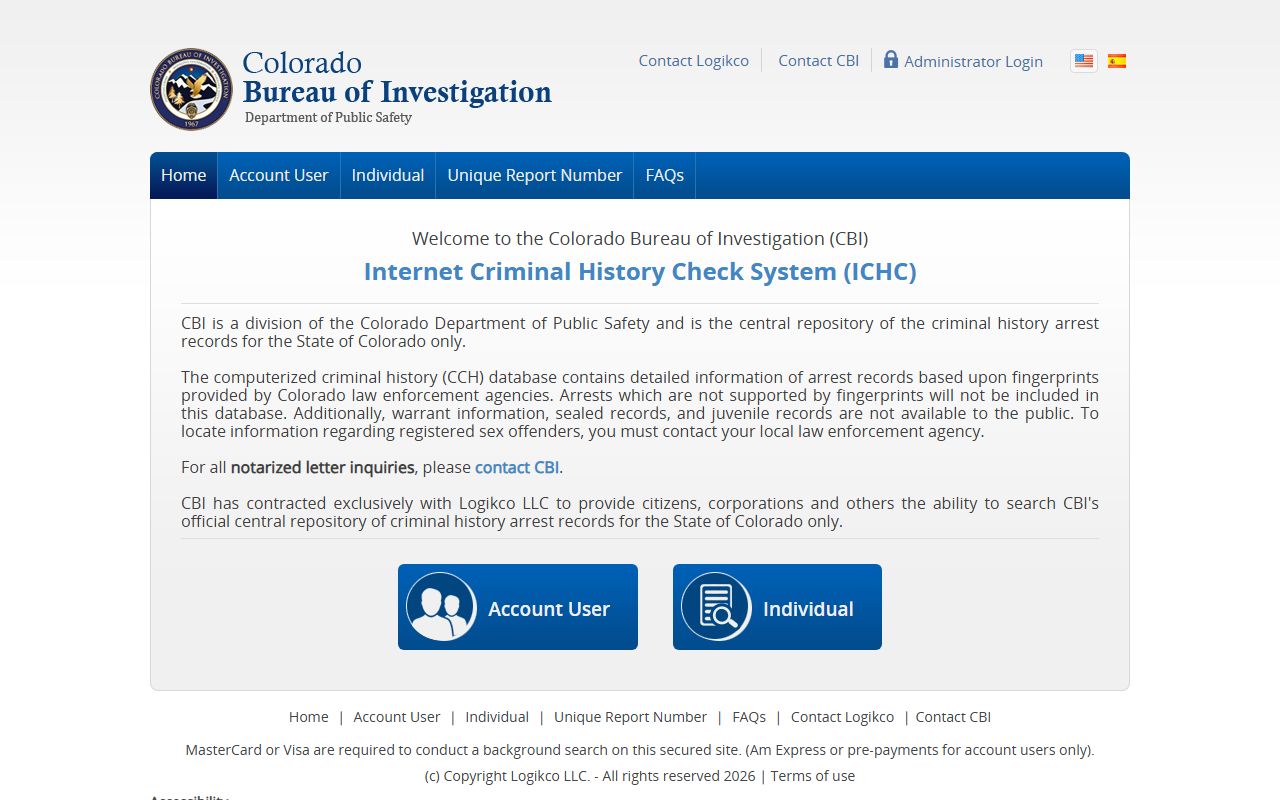 It asks for name, date of birth, and other identifiers, then returns a fingerprint-supported arrest history from agencies across the state.
- Open the Denver County Court portal and pick Case Search for a known case number or AB number.
- Switch to the Colorado Judicial docket search for a felony filed in District Court; filter by Denver - District and case class CR.
- Add a date range and a second filter such as party name or attorney to narrow results.
- Open the docket hit and note the case number, courtroom, judge, hearing type, and disposition.
- Run a CBI Internet Criminal History Check for the full statewide arrest record on a named person.
- Use the Denver Sheriff inmate search to confirm a current booking, facility, and charges.
- Order certified copies through the County Court criminal clerk at 720-337-0410 or the District Court records counter.
Note: The Denver County Court portal does not allow person or business name search, so a name-only lookup must start with the state docket search or the CBI history check.
Types of Denver Criminal Records
Denver splits criminal cases across three trial courts. The Denver District Court at the Lindsey-Flanigan Courthouse hears felony cases, from drug and theft charges through assault and homicide. Denver County Court at the same site hears state misdemeanors, municipal cases, and early felony stages such as advisement, bond, and preliminary hearings. The Denver Sheriff Department creates the arrest record at booking.
The Denver Sheriff Department page sets out the sheriff's role in jail operations and court security. 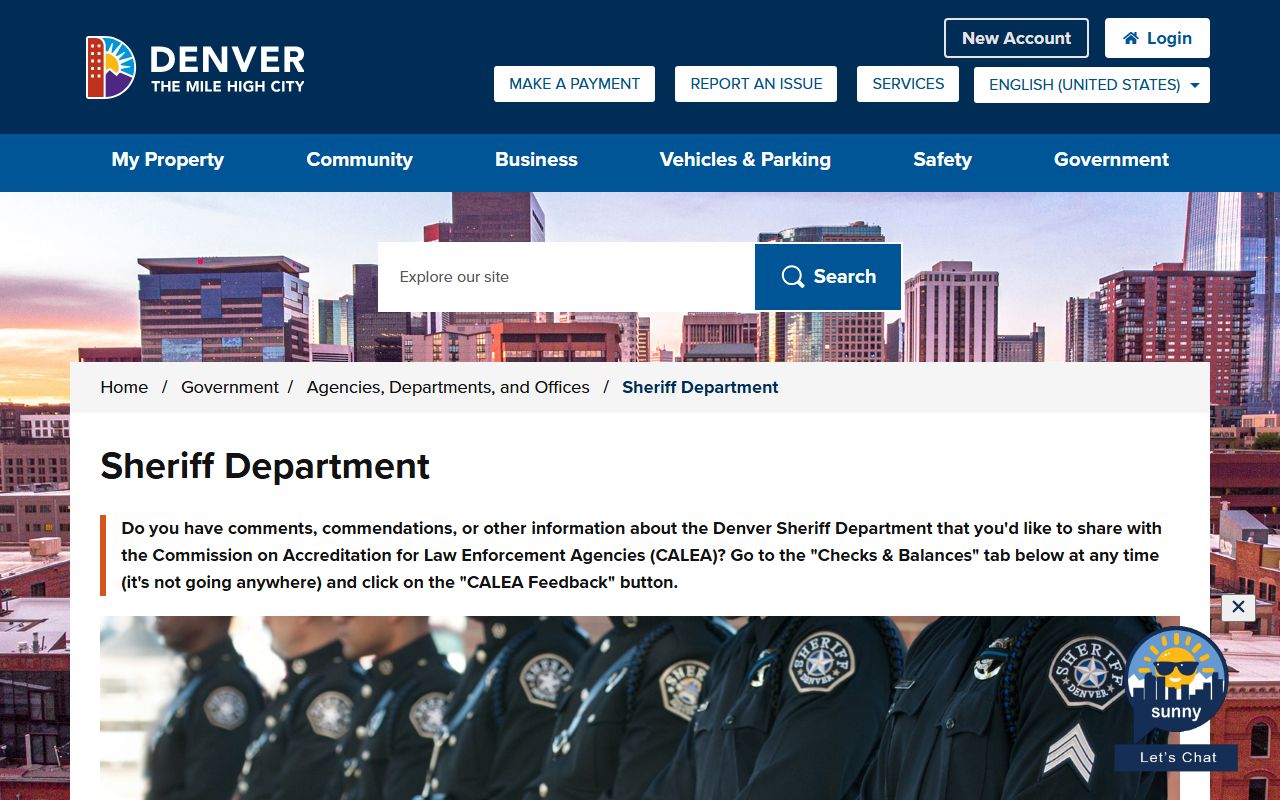 The page names Sheriff Elias A. Diggins and points to over 1,100 staff, two detention sites, and the inmate lookup.
Criminal record categories in Denver:
- Felony case files at District Court, case class CR; sample numbers run 2025CR6963 and 2026CR1442.
- Misdemeanor and municipal case files at County Court, with case classes such as C, CR, M, GS, and GV.
- Traffic crime files such as DUI and DWAI, routed to County Court traffic but added to the criminal record.
- Arrest and booking data held by the Sheriff Department at Downtown Detention Center and Denver County Jail.
- Warrant holds showing as case type WARRANT - DENVER HOLD in the inmate file.
- Juvenile delinquency files at Juvenile Court, case class JD, with limited public access.
What a Denver Criminal Record Shows
A Denver criminal court file starts as a complaint or information that names the defendant, lists the charges, and cites the statute. The clerk then adds bond paperwork, hearing minutes, motion filings, and orders as the case moves. The register of actions, often called the ROA, is the date-ordered list of every event, filing, and order.
Typical fields on a Denver criminal file include:
- Case number, case class, court, division, judge, and case status.
- Complaint or information with charge text, statute cite, and offense level.
- Warrant entries, bond orders, bail amount, and any no-contact or protection order.
- Hearing minutes from arraignment, preliminary hearing, motions, and sentencing.
- Disposition or plea text and the sentence order with fines, jail, probation, or restitution.
Social Security numbers, financial accounts, protected addresses, juvenile names, and mental health material are redacted under court rules.
Denver Charges vs. Convictions
A charge is not a finding of guilt. A person is charged at arrest or by information, but the law treats them as innocent until a court or jury says otherwise. A conviction comes only after a guilty plea, a no-contest plea, or a verdict at trial. Many filed charges never reach conviction.
| Charges | Convictions | |
|---|---|---|
| Stage | Filed at arrest or by information | Entered after plea or trial verdict |
| Legal status | Presumption of innocence applies | Guilt set under due process |
| Can change | May be amended or dropped | Final unless appealed |
| Burden of proof | Probable cause | Beyond a reasonable doubt |
| Public visibility | Public unless sealed | Public unless sealed or expunged |
Background screeners often pull both arrest and conviction data, which is why a charge can hurt long after a case is dropped. Sealing is one path to take old or non-conviction filings out of public view.
Sealed vs. Expunged in Colorado
Colorado treats sealing and expungement as two different things. Sealing applies mostly to adult records under C.R.S. § 24-72-703 and related statutes. Expungement is used mainly for juvenile records and follows reforms in HB17-1204 and HB19-1335.
| Sealed (Adult) | Expunged (Juvenile) | |
|---|---|---|
| Statute | C.R.S. § 24-72-703 et seq. | Title 19; HB17-1204; HB19-1335 |
| Effect | Restricts public access | Treats record as if it never existed |
| Who still sees | Courts, prosecutors, agencies, parties | Very limited retention |
| Process | Petition in court of record | Some automatic; some by petition |
| Common bars | Domestic violence, sex offenses | Serious juvenile felonies |
The Legislative Council memo on sealing and expunging criminal records is the best plain-English map of the process. Bill text for HB17-1204 and HB19-1335 covers the juvenile reforms.
Note: Denver District Court's self-help center helps unrepresented people file sealing petitions, but staff cannot give legal advice.
Denver Booking and Intake Process
Once a person is arrested in Denver, police hand them off to the Denver Sheriff Department for booking. The Sheriff runs intake at the Downtown Detention Center and the Denver County Jail. Police make the arrest; the Sheriff holds and processes the person. That split matters when you trace a record back to its source.
The Sheriff's Family and Friends Guide spells out the intake steps:
- A pat search and a metal detector search are run, with property pulled and stored.
- A digital mugshot and right index fingerprint are taken at booking.
- Medical and mental health staff run health screens before housing.
- Property is inventoried, logged, and stored for release.
- Fingerprint cards are sent to the FBI and CBI for clearance.
- The Denver Police Identification Bureau checks for added warrants once prints are classed.
Classification staff then place the person in a housing unit using an objective system that weighs offense severity, prior convictions, and behavior on past stays.
Denver Mugshots and Booking Photos
Denver takes a digital mugshot at booking, but the public inmate search does not show it on the result page. The lookup focuses on name, age, sex, race, facility, booking status, CD number, and booking number. No photo appears in the public profile.
The Denver inmate search is the official tool for confirming custody. 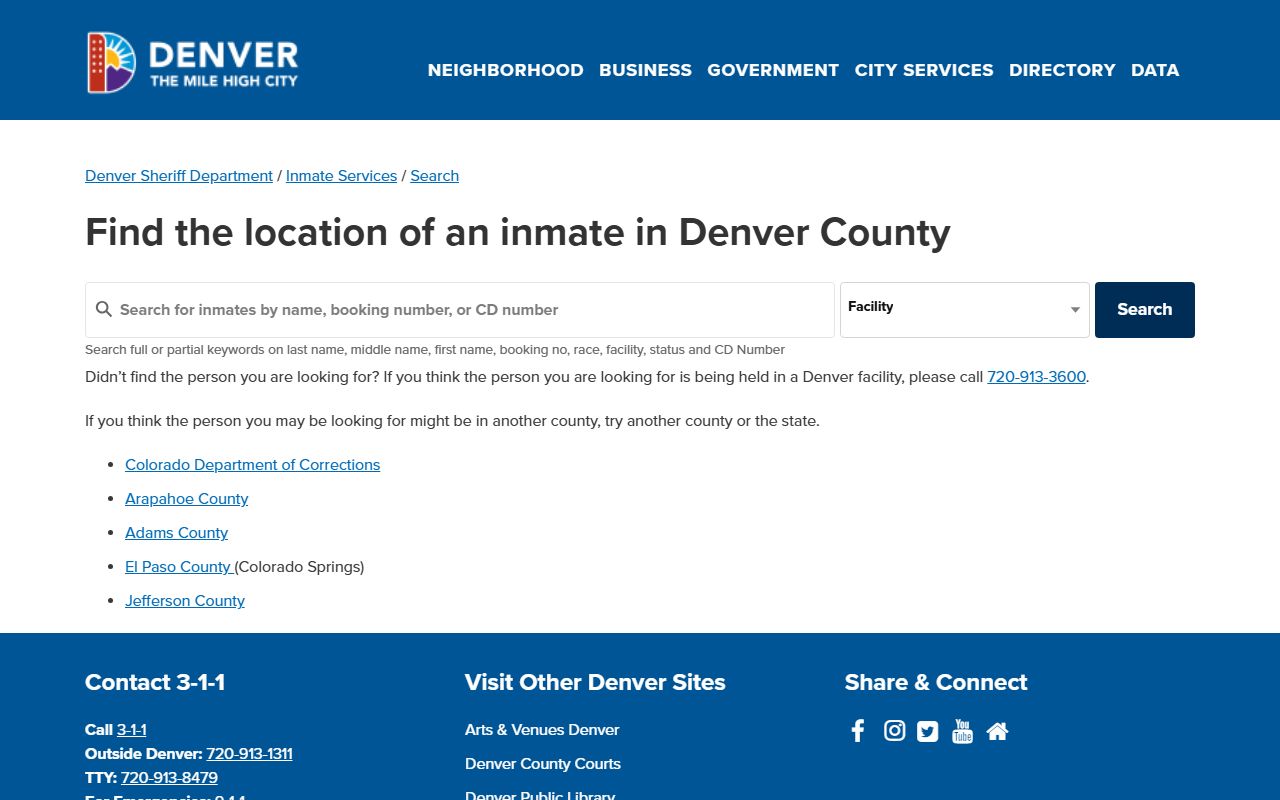 The search bar accepts last name, first name, booking number, race, facility, or CD Number, with a facility dropdown between County Jail and Downtown Detention Center.
The CBI check also does not return a mugshot. People who need one must ask the arresting agency in writing under the Criminal Justice Records Act, and release stays at the agency's discretion.
Public Access Laws for Denver Criminal Records
Colorado does not run criminal record access under a single law. Court files fall under Chief Justice Directive 05-01 and P.A.I.R.R. 2. Police, sheriff, and prosecutor records fall under the Colorado Criminal Justice Records Act. Other government records use the Colorado Open Records Act, or CORA.
Statutes and rules that touch Denver criminal records:
- Criminal Justice Records Act, C.R.S. § 24-72-301 et seq. Covers police, sheriff, DA records.
- Colorado Open Records Act, C.R.S. § 24-72-200.1 et seq. Covers non-court government records.
- Chief Justice Directive 05-01. Sets public access policy for state courts; amended 2024 and 2025.
- Children's Code, C.R.S. § 19-1-301 et seq. Limits access to juvenile records.
Full statute text is on the Colorado Revised Statutes site. The Access Guide to Public Records and the text of CJD 05-01 are on the Colorado Judicial site. Denver County Court data requests go to coradatarequests@denvercountycourt.org.
Statewide CBI Criminal History Check
The CBI runs the only official state-level criminal history check in Colorado. It is fingerprint-based, pulls from Colorado law enforcement agencies, and returns a single arrest-history file for a named person. Anyone can use it for a fee, and consent from the subject is not required.
What the CBI public CCH database includes and excludes:
- Includes Colorado arrests supported by fingerprints from local and state agencies.
- Includes case dispositions where the court has reported them back to the state.
- Excludes warrant information; warrants must be checked with the court or police.
- Excludes sealed records and juvenile records.
- Excludes federal arrests and out-of-state records held by other states.
Note: The CBI public check is not a fingerprint-based applicant check and should not stand in for a certified fingerprint screening.
Sealing or Expunging Denver Criminal Records
The Colorado sealing path turns on the case outcome, offense type, wait period, and victim rights. A dismissed case can often be sealed faster than a conviction. Some offenses can never be sealed, such as most domestic violence and sex offenses.
Steps to seal a Denver adult criminal record:
- Pull a CBI criminal history to identify each case to seal.
- Check the eligibility chart in the Legislative Council memo.
- Fill the Colorado Judicial sealing petition forms tied to the offense type.
- File in the court of record and serve the Denver DA's Office.
- Wait for the DA response window; the court may set a hearing on objections.
- If granted, the order seals the file from public court systems and the CBI public check.
Denver District Court's Pro Se Center walks unrepresented people through sealing forms. Juvenile expungement under HB17-1204 and HB19-1335 is often automatic for qualifying outcomes.
Denver District Attorney and Public Defender
Denver District Attorney John Walsh runs the DA's Office for the Second Judicial District. The DA prosecutes felony and most misdemeanor cases filed in Denver and runs diversion programs, victim and witness services, and crime victim compensation. The Victim Advocates line is 720-913-9000. The Denver District Attorney site covers prosecution, victim services, and diversion FAQs, and the DA contact page lists office details.
People who cannot afford a lawyer in a Denver criminal case can apply through the Colorado State Public Defender. The state office runs trial offices in each district, including a Denver trial office covering the Second Judicial District. Public defenders handle only criminal matters. The Colorado State Public Defender site has the office locator and the application path for indigent defense.
Denver Background Check Considerations
Background checks split into two worlds. The CBI Internet Criminal History Check is the official state system, fingerprint-supported, and run by a Colorado government agency. Third-party background sites are not official and may use stale or wrong data. The Fair Credit Reporting Act sets the rules for any check used for jobs, housing, credit, or insurance.
Important: This site is not a consumer reporting agency under the FCRA, and the data here may not be used for jobs, housing, credit, insurance, or other FCRA-regulated purposes.
For any hire, lease, or credit-related check, use a CBI report or an FCRA-compliant vendor. Casual personal lookups should still be checked against the source court file.