
How to Search Denver County Court Records
Denver splits court records across three official systems. The Denver County Court public portal covers County Court cases by case number or arrest booking (AB) number. The Colorado Judicial Branch docket search covers Denver District, Probate, and Juvenile dockets. Document copies still come from the proper clerk. The County Court portal does not allow name search. The state docket search does support party name search, but pulling the actual filing means a record request.
The Denver County Court site is the first stop for most local users. Its homepage links the case search, docket search, e-filing system, and a Court Services page that lists fees and copy office addresses. Before you start, gather the case number or AB number, the party's full legal name, the date of birth if you have it, and the year of filing. The portal flags case search as the fastest route. If you only have a name, the official page sends you to the state docket search or to a commercial register-of-actions vendor.
A quick way to get into the system is through the case lookup tool itself. The Denver County Court case search shows the simple Case Number / AB# form. 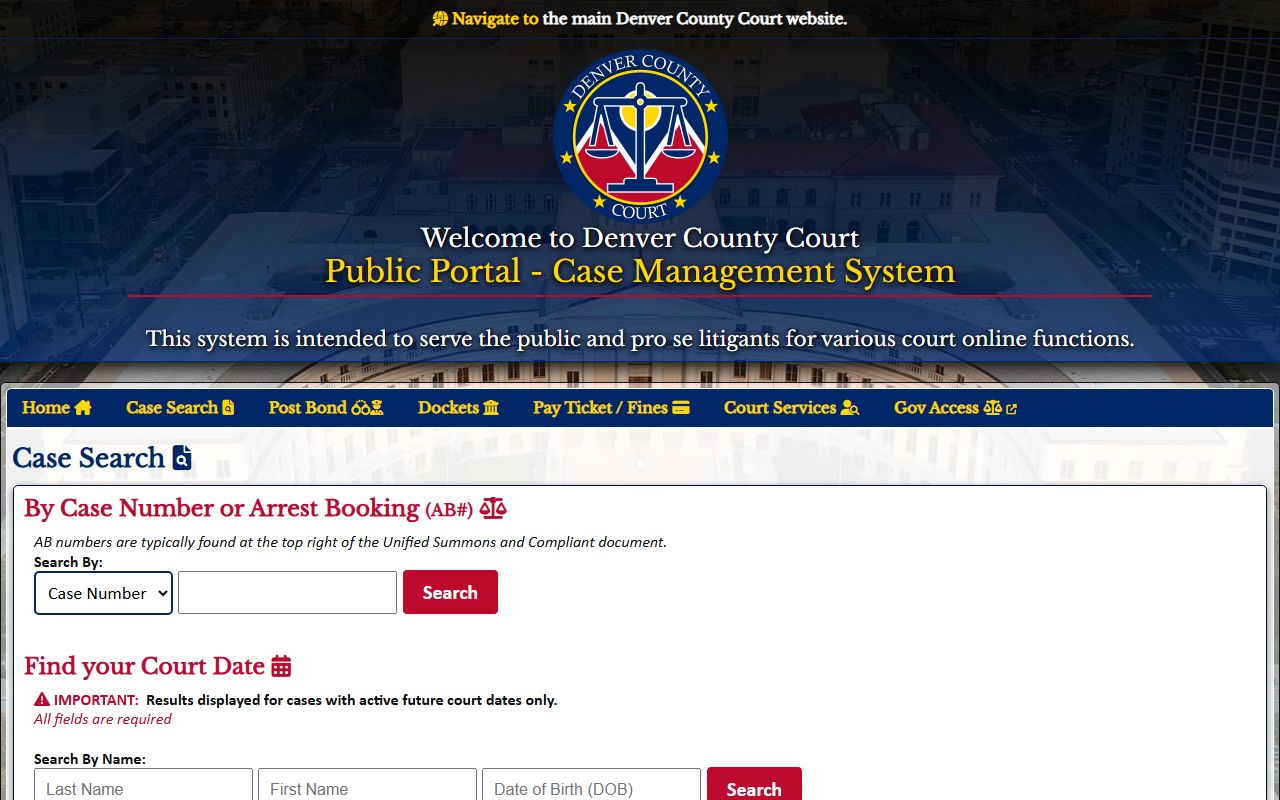 The case-number form sits at the top, with the court-date lookup, civil court-date lookup, and search-by-name-or-business panels below. The portal will not return documents, even when it finds a case. Documents come from the clerk.
- Open the Denver County Court portal at public.denvercountycourt.org and choose Case Search.
- Pick Case Number or AB# and type the value exactly. AB numbers sit at the top right of the Unified Summons and Complaint.
- If you have only a name, switch to the Colorado Judicial docket search and filter to Denver - District, Denver - Probate, or Denver - Juvenile.
- Add a date range and one extra filter such as case class (CR, CV, DR, PR, JV, JD, T) or party name.
- Review the docket hit. Confirm the case number, courtroom, hearing type, and judge.
- Submit the Colorado Judicial record/document request form or email the right clerk to order copies.
- Pay the copy fee at $0.25 per page, plus $20 per document for certified copies if needed.
The County Court portal also has a Court Services page that lays out the public-record rules and the right copy office for each case type. The Court Services page spells out what the public portal can and cannot do. 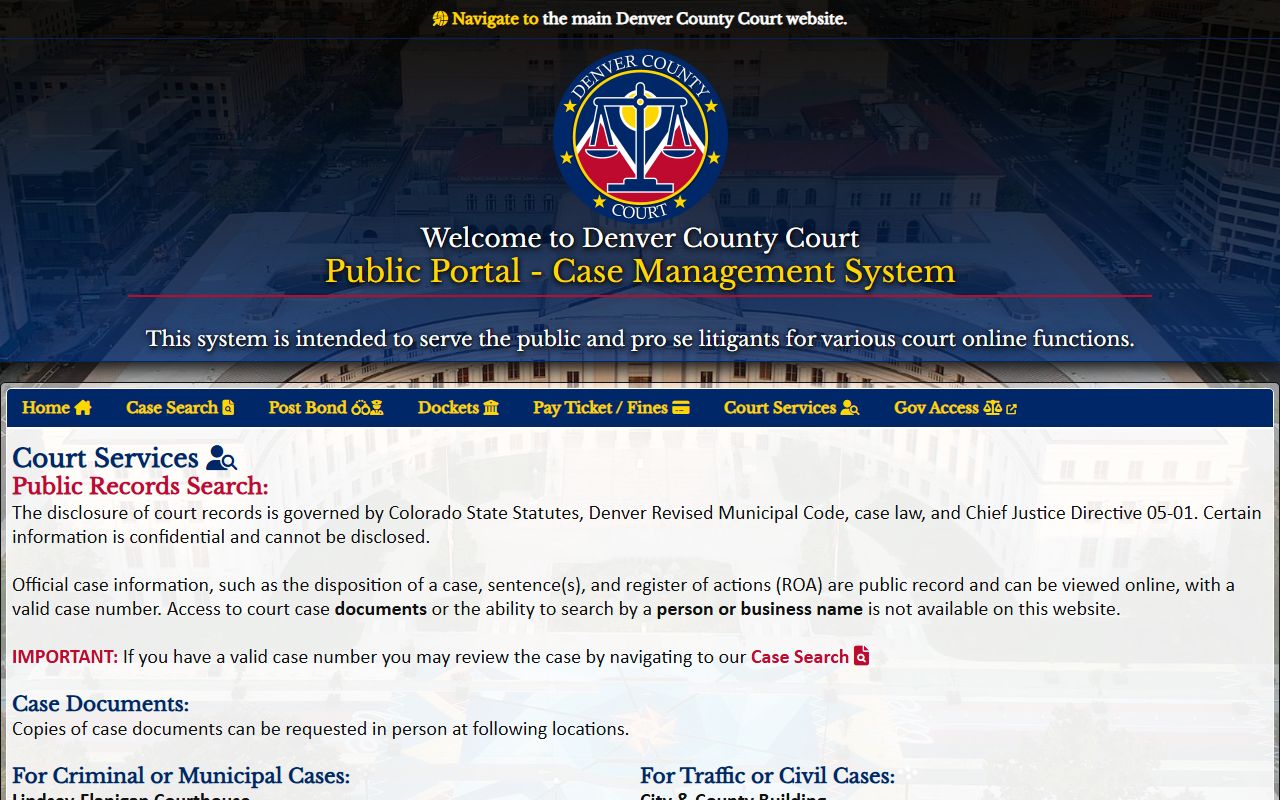 It states that case disposition, sentence, and register of actions can be viewed online with a valid case number, but case documents and person/business name search are not on the public site. The page also points criminal copies to Room 160 at Lindsey-Flanigan and traffic or civil copies to Room 135 at the City and County Building.
Below is the field list the County Court case search asks for, taken directly from the live form.
| Field | Type | Required | Notes |
|---|---|---|---|
| Search By | Toggle | Yes | Case Number or AB#. |
| Case / AB input | Text | Yes | Validation: "Please enter case". |
| Last Name | Text | Yes for court-date lookup | Active future court dates only. |
| First Name | Text | Yes for court-date lookup | Active future court dates only. |
| DOB | Date | Yes for name lookup | Date of birth required. |
| Business | Text | Conditional | Used for civil court-date by business. |
The Denver County Judicial System
Denver is the only Colorado judicial district that is not a combined court. The Second Judicial District holds four separate trial courts: Denver County Court, Denver District Court, Denver Probate Court, and Denver Juvenile Court. The Probate Court is treated as the 24th Judicial District for probate business. Each court keeps its own records and uses its own clerk's office. That setup confuses first-time users, since most other Colorado counties merge District and County functions into one combined clerk.
Chief Judge Christopher J. Baumann presides over the Denver District Court bench in Division 259. The Denver District Court runs civil and domestic-relations matters from 1437 Bannock Street and felony criminal matters from 520 West Colfax Avenue. The Denver District Court judges and staff page lists each judge, division, and direct phone line. 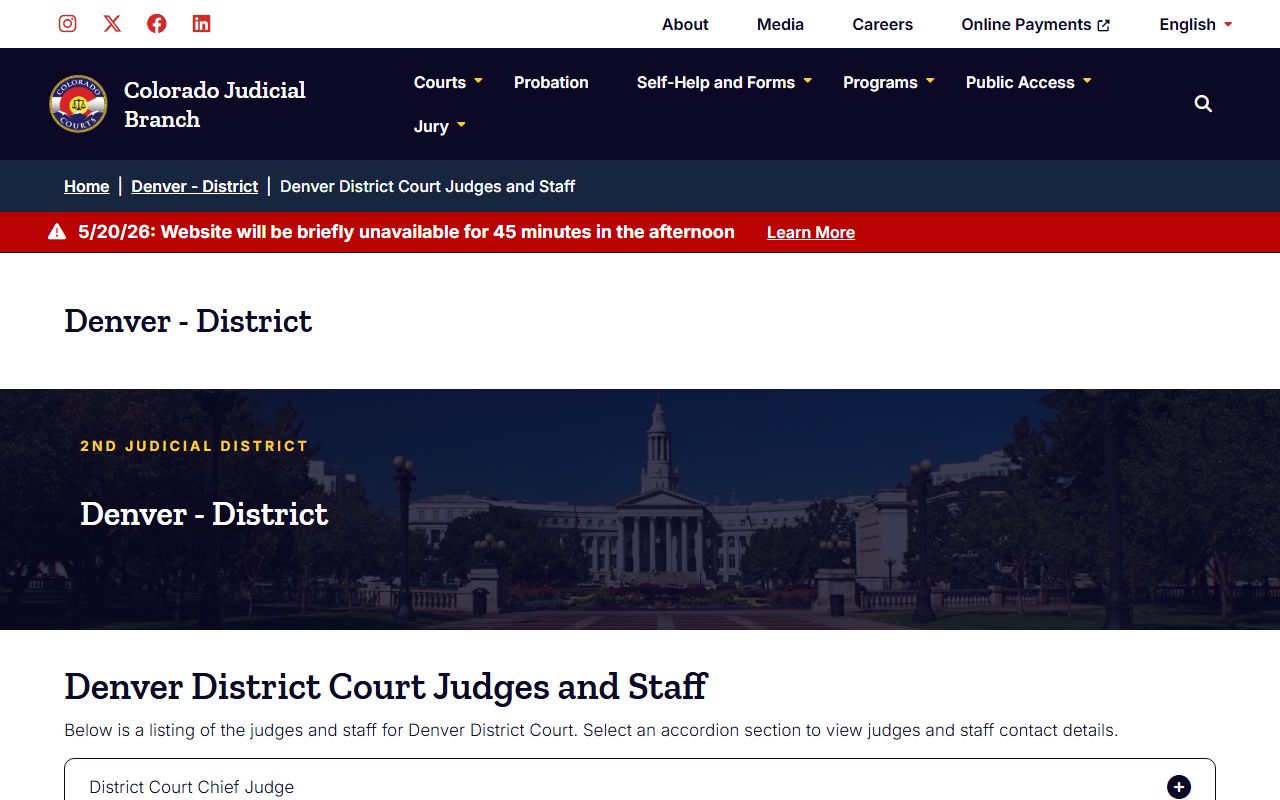 The list pairs each judge with a division number such as 5A or 4G and a 303-606 phone extension routed through the records counter.
The Colorado Judicial Branch Denver District Court page covers the rest of the structure: civil and domestic divisions, the records counter, online forms, and self-help. 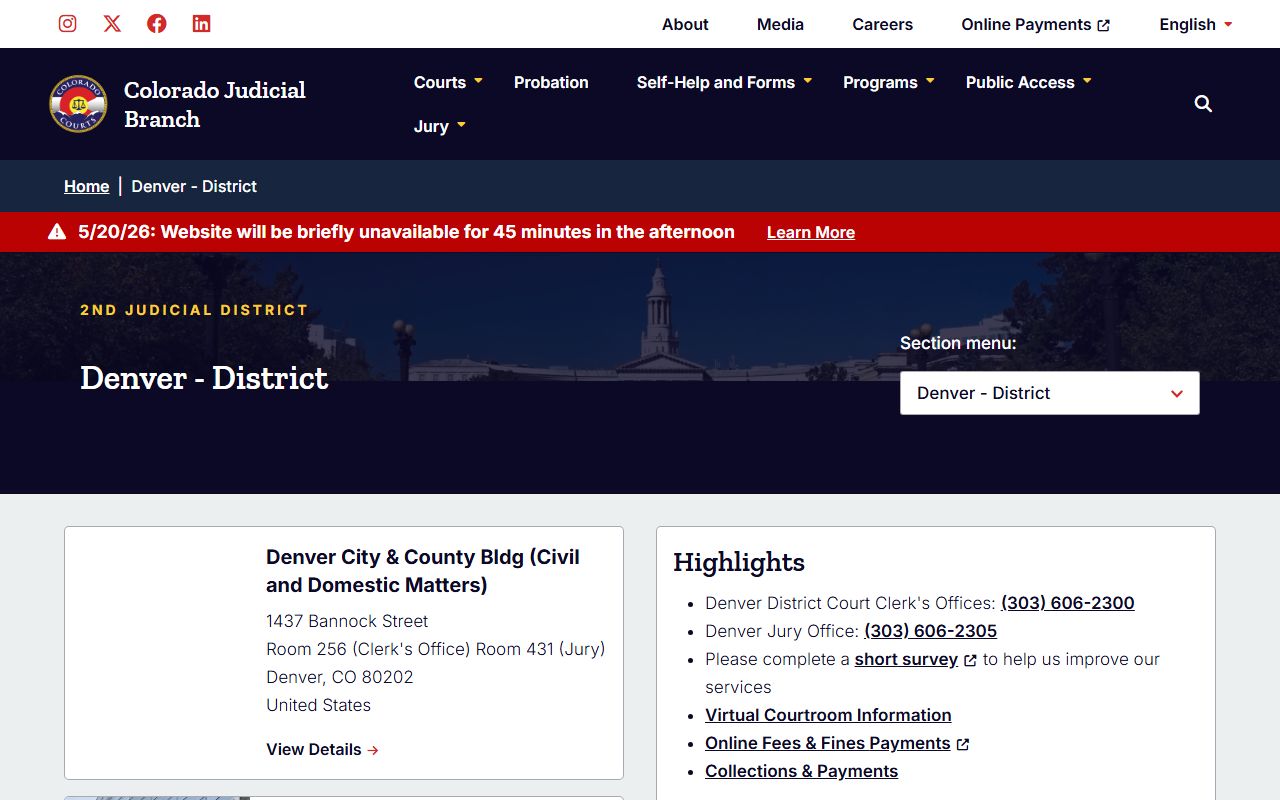 The state page also links the docket search, ADA accommodations, and interpreter requests. Denver County Court runs its own systems outside the state site, while District, Probate, and Juvenile use state portals.
Case flow: Denver County Court › Denver District Court › Colorado Court of Appeals › Colorado Supreme Court
| Court | Jurisdiction | Case Types | Main Courthouse |
|---|---|---|---|
| Denver County Court | Limited jurisdiction trial court | State misdemeanors, municipal criminal, traffic, civil up to $25,000, small claims, protection orders, felony advisement and bond | 520 W. Colfax (criminal); 1437 Bannock (civil/traffic) |
| Denver District Court | General jurisdiction trial court | Felony criminal, domestic relations, larger civil cases, juvenile delinquency on appeal | 520 W. Colfax (criminal); 1437 Bannock (civil/DR) |
| Denver Probate Court | 24th Judicial District; exclusive probate | Estates, wills, trusts, guardianships, conservatorships, mental illness adjudication | 1437 Bannock Street, Room 230 |
| Denver Juvenile Court | Separate juvenile trial court | Dependency and neglect, delinquency, paternity, adoption, relinquishment | 520 W. Colfax, Room 125 |
Denver County Courthouses
Three buildings carry most Denver court traffic. The City and County Building at 1437 Bannock Street holds Denver District civil and domestic divisions, Denver County Court civil and traffic divisions, and Denver Probate. The Lindsey-Flanigan Courthouse at 520 West Colfax Avenue holds criminal courts, including District felony divisions, County Court criminal and municipal divisions, and Juvenile Court. The Ralph L. Carr Judicial Center at 2 East 14th Avenue hosts the Colorado Supreme Court and the Colorado Court of Appeals. All three sit within a short walk of each other near Civic Center.
Self-help centers live inside the building stack. The District Court Pro Se Center supports DR family-law users and people who want to seal a criminal record. The Probate Self-Help office sits in Room 230 of the City and County Building. The Juvenile Self-Help Resource Center is in Room 125 of Lindsey-Flanigan, open Monday-Friday 9 a.m.-12 p.m. and 1 p.m.-4 p.m. The court records counter for District Court is in Room 256 of the City and County Building, open weekdays 8 a.m. to 4 p.m. The Denver County Court e-filing portal lets attorneys and self-represented parties file most county cases online. 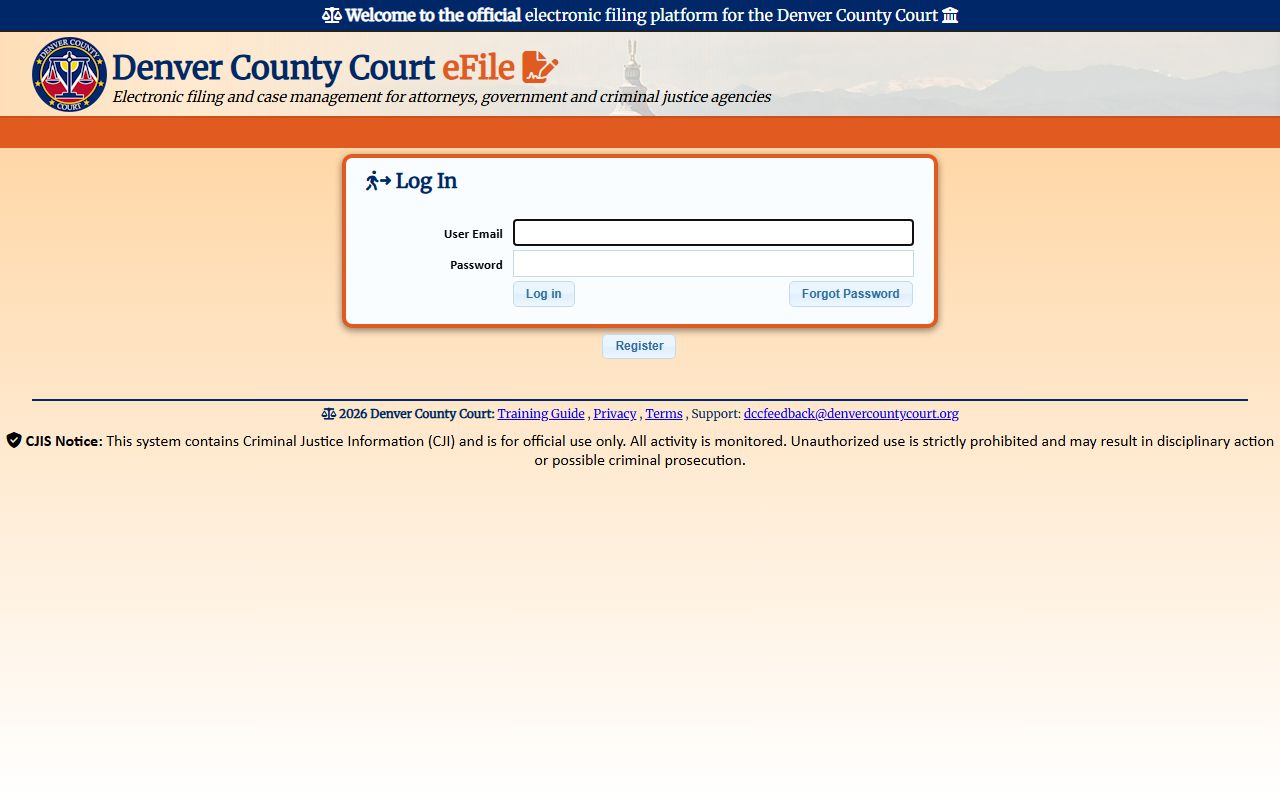 The e-filing system is run on GovAccess and includes traffic, civil, small claims, and many municipal case types.
Lindsey-Flanigan Courthouse
520 West Colfax Avenue
Denver, CO 80204
720-337-0410
Types of Court Records Available in Denver County
Denver court records cover every major case class produced by a state trial court system. Civil filings, criminal complaints, traffic citations, family matters, probate estates, juvenile cases, and protective orders all generate dockets, orders, judgments, and registers of action. Each court owns its own files. County Court records sit at the County Court clerks. District, Probate, and Juvenile records sit with the Colorado Judicial Branch clerks at 1437 Bannock and 520 W. Colfax.
The Denver County Court docket dropdown gives a sense of the spread. Courtrooms include criminal, traffic, civil, DMHC mental health, and ESCUR. The state docket search supports case classes C, CR, CV, CW, DR, JD, JV, M, PR, R, S, and T. Local County Court cases also use GS, GV, and D series patterns in the state record request notes. Knowing the class helps narrow searches and find the right clerk.
- Criminal records - Denver County Court for state misdemeanors and municipal cases; Denver District Court for felonies, including charges, dispositions, sentences, and protection orders. Read more on the criminal records page.
- Civil records - County Court for cases up to $25,000 and small claims; District Court for larger civil and complex litigation. Documents include complaints, answers, motions, orders, and judgments.
- Family and domestic relations records - District Court divorce decrees, parenting plans, separation agreements, support orders, and protection orders. See marriage and divorce records.
- Probate records - Denver Probate Court estates, wills, trusts, guardianships, conservatorships, and mental illness adjudication. Details on the probate records page.
- Traffic records - County Court traffic citations, pleas, fines, and dispositions. See the traffic court records page.
- Juvenile records - Denver Juvenile Court delinquency, dependency, paternity, and adoption. Access is limited under § 19-1-301 et seq.
What Denver County Court Records Show
A typical Denver case record reads like a chronological file. The header lists the case number, class, filing year, court, division, and current status. The body holds parties, attorneys, and a register of actions that tracks each filing, hearing, and order. Public dockets show the calendar view: date, time, party name, case number, hearing type, courtroom, and appearance mode. They do not show the documents themselves. Documents come from a clerk request.
Case numbers in Denver follow patterns that point to the court and class. A felony case may read 2025CR6963. A civil case may read 24CV30459. A domestic-relations case ends in DR, a juvenile delinquency case in JD, a juvenile case in JV, a probate case in PR, and a traffic case in T. Knowing the year, the class, and the four-digit sequence is enough to pull a docket entry on the state portal. Each docket entry includes the assigned division courtroom number such as 4G or 5H.
| Field | What It Shows |
|---|---|
| Case Number | Four-digit year, case class (CR, CV, DR, JV, JD, PR, T), and sequence (e.g., 2025CR6963). |
| Filing Date | Date the case was opened with the court clerk. |
| Parties | Plaintiff or petitioner, defendant or respondent, decedent, ward, or protected party. |
| Charges / Cause | Charge level (F, M, O), offense code such as 18-3-203, and offense type. |
| Disposition | Outcome of the case or charge: pleas, verdicts, dismissals, or transfers. |
| Sentence / Judgment | Final order: jail, probation, fines, restitution, money judgment, or estate closure. |
| Hearing Type | Arraignment, status conference, pretrial, sentencing, return on summons, or warrant appearance. |
| Courtroom / Division | Division code such as 4G, 5A, 100K, or DMHC mental health docket. |
Public Access Laws for Denver County Court Records
Court records in Denver are not simply CORA records. The Colorado Judicial Branch states that court records are open at reasonable times under Chief Justice Directive 05-01 and the Supreme Court Rule on Public Access to Information and Records, often called P.A.I.R.R. Criminal court records are also shaped by the Colorado Criminal Justice Records Act, found at C.R.S. § 24-72-301 et seq. Denver County Court applies state statutes, the Denver Revised Municipal Code, case law, and CJD 05-01 to its own files. CORA still applies to many city and agency records, including those held by the Denver Clerk and Recorder, but it is not the sole rule for court files.
The result is a layered framework. CORA sets the baseline for public records held by Colorado state and local government. CJRA narrows access to criminal justice records held by police, sheriff, and prosecutors. CJD 05-01 governs the courts themselves. The Public Access Committee meets quarterly and reviews Judicial Branch access policy. Fees are tied to CJD 06-01 and the fee schedule on the state record request form. Most requests get a response within three business days unless extenuating circumstances apply.
Key Statutes:
Colorado Revised Statutes § 24-72-200.1 et seq. - Colorado Open Records Act (CORA); sets the default right to inspect public records held by state and local agencies.
Colorado Revised Statutes § 24-72-301 et seq. - Colorado Criminal Justice Records Act (CJRA); controls access to police, sheriff, and prosecutor records.
Chief Justice Directive 05-01 - Judicial Branch directive that balances public access to court records with privacy and statutory limits.
Records That Are Restricted or Confidential
Some Denver court files are closed by statute or by court order. Juvenile case records sit under C.R.S. § 19-1-301 et seq. and CJD 05-01. Access goes to parties, attorneys, agencies, and people authorized by statute or court order. Adoption files are confidential and need party status or a court order to view. Mental health adjudications inside Probate Court can require ID or be restricted. Sealed adult criminal records remain available to parties and to criminal justice agencies, but not to the general public. Expunged juvenile records, under HB17-1204 and HB19-1335 reforms, drop out of routine public search results.
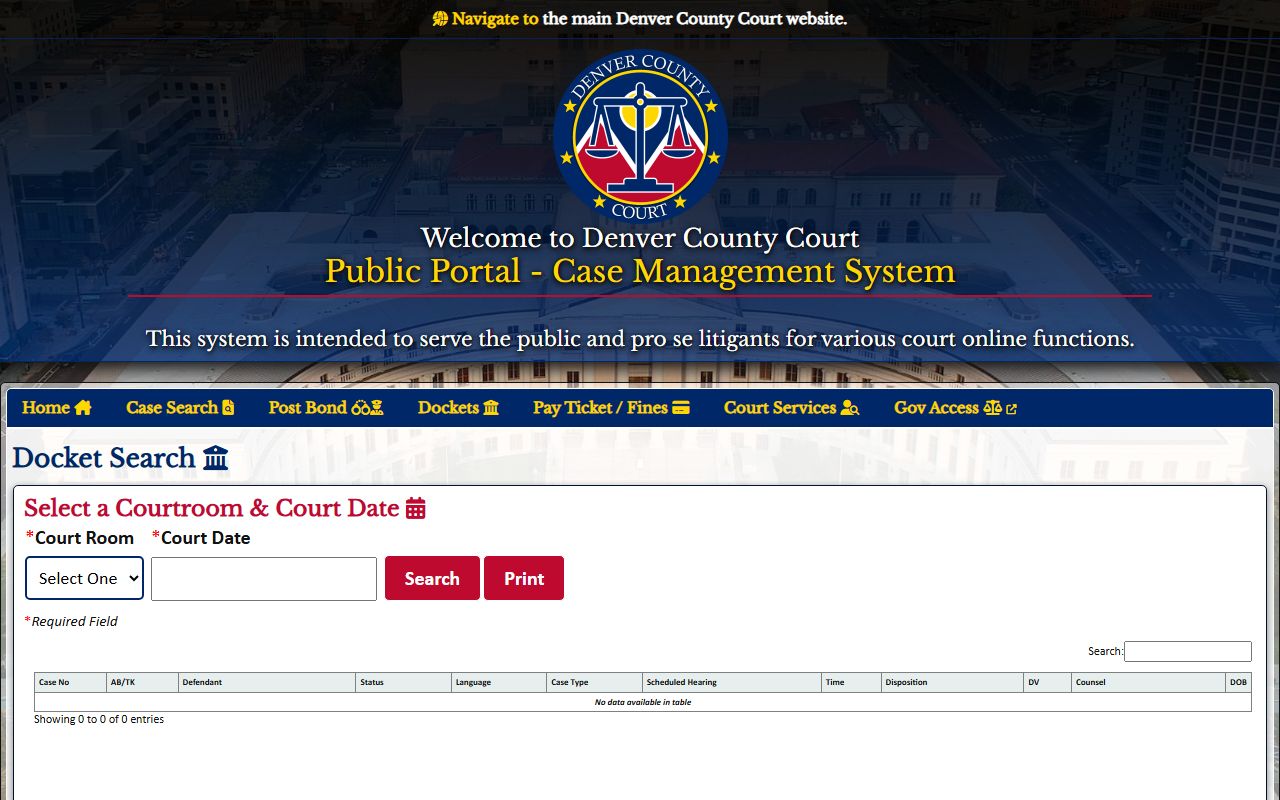 The County Court docket form returns hearing data, but redactions still apply. Date of birth and protected addresses are hidden in many public docket views. Suppressed cases, juvenile and probate files, and documents with confidential content may require a U.S. government photo ID at the clerk's counter. Personal identifiers such as Social Security numbers, financial account numbers, minor names, and protected addresses are redacted in most documents that reach the public. Grand jury and sealed warrant materials stay private until released by the court.
To open a sealed file, an interested party files a motion in the court that handles the case. Denver District Court self-help can guide pro se filers through criminal record sealing. The Legislative Council memo on sealing and expungement spells out who qualifies, the waiting periods, and the exclusions for sex offenses and domestic violence convictions. Eligibility depends on offense level, outcome, time since the case closed, victim-rights rules, and any later convictions.
Note: Some Denver case data is sealed by law, so an empty search result does not always mean a case never existed.
Specialty Courts in Denver County
Denver runs several problem-solving and treatment-focused dockets. The County Court docket dropdown lists DMHC, which corresponds to a Denver mental health docket. Mental health cases tied to misdemeanors and municipal offenses route through DMHC to link defendants with treatment, case management, and supervision. The DMHC label also appears in scheduled hearings on the public docket portal, which makes it visible to families and advocates who want to track a case.
Veterans get a dedicated track that combines court and custody supports. The Housing Unit for Military Veterans, called HUMV, launched at the Van Cise-Simonet Detention Center and houses up to 64 men. HUMV works with Denver Veterans Court, the VA Eastern Colorado Health Care System, and community partners on job training, employment, housing, pre-apprenticeship slots, and individualized reentry plans. The unit uses a modified therapeutic community model and offers PTSD treatment, anger management, financial literacy, AA and NA meetings, and substance use programs.
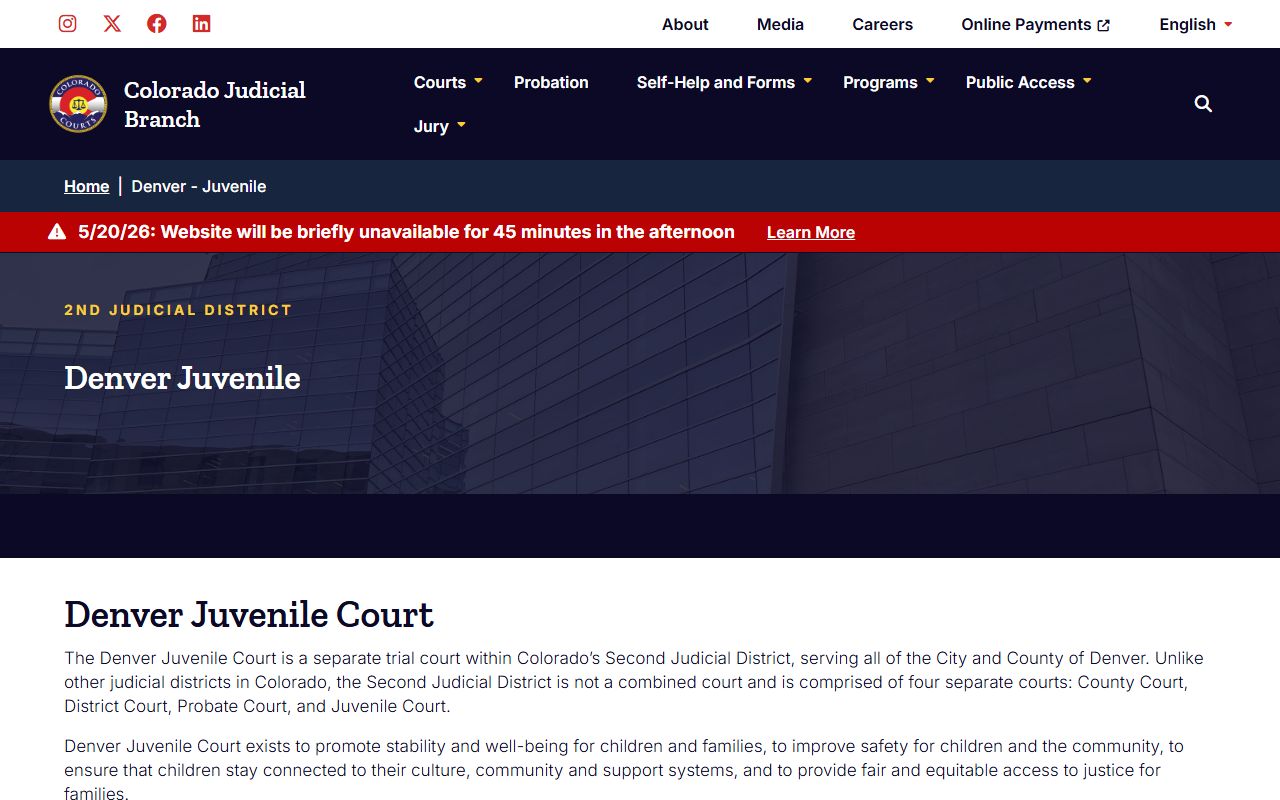 The Denver Juvenile Court page highlights the Youth and Family Treatment Court (YFTC). YFTC is a treatment-focused docket for juveniles and families. Other Denver-related programs run from inside the jails: the RISE program offers intensive jail-to-community recovery support; MAT and J2C deliver methadone, buprenorphine, Sublocade, Vivitrol, case management, peer support, and release planning. Each track shows up in court orders and probation records as a condition or referral.
Denver County Sheriff and Jail
Sheriff Elias A. Diggins leads the Denver Sheriff Department, which Denver calls the largest sheriff department in Colorado. The agency has over 1,100 uniformed and non-uniformed staff and runs two main jail facilities: Denver County Jail at 10500 E. Smith Road and the Downtown Detention Center, also called Van Cise-Simonet, at 490 W. Colfax Avenue. The Sheriff also provides court security for District and County buildings, transports state inmates, handles extraditions, supports fugitive and K-9 units, runs the vehicle impound facility, and secures Denver Health and Medical Center. Denver Police is a separate agency that handles patrol and arrests.
Bookings sit near 23,558 per year, with an average age of 39 and an average length of stay of 18 days. The Sheriff publishes interactive population dashboards and annual reports. The Crisis Response Team logged 3,034 crisis incidents in 2025, about 11 a day. Mental health alerts apply to roughly 5% of bookings. The full daily roster sits in the Denver inmate lookup. To find or verify custody, use the Denver County inmate records page for the search tool, the warrant records page for warrant-related holds, and the released inmates page for VINELink and reentry resources. The jail information line is 720-913-3600.
Marriage, Divorce, and Probate Records
Marriage licenses are not a court record. The Denver Clerk and Recorder, led by Paul D. López, issues licenses, records documents, and runs elections. Marriage and civil union licenses cost $30 and the office is at 200 West 14th Avenue. Divorce filings, on the other hand, are Denver District Court domestic-relations records. The Clerk and Recorder explicitly does not process or keep dissolutions. Estates and guardianships go to the Denver Probate Court at 1437 Bannock Street, Room 230. Read more on the marriage and divorce records page and the probate records page.
The Denver Probate Court location page gives the in-building directions. 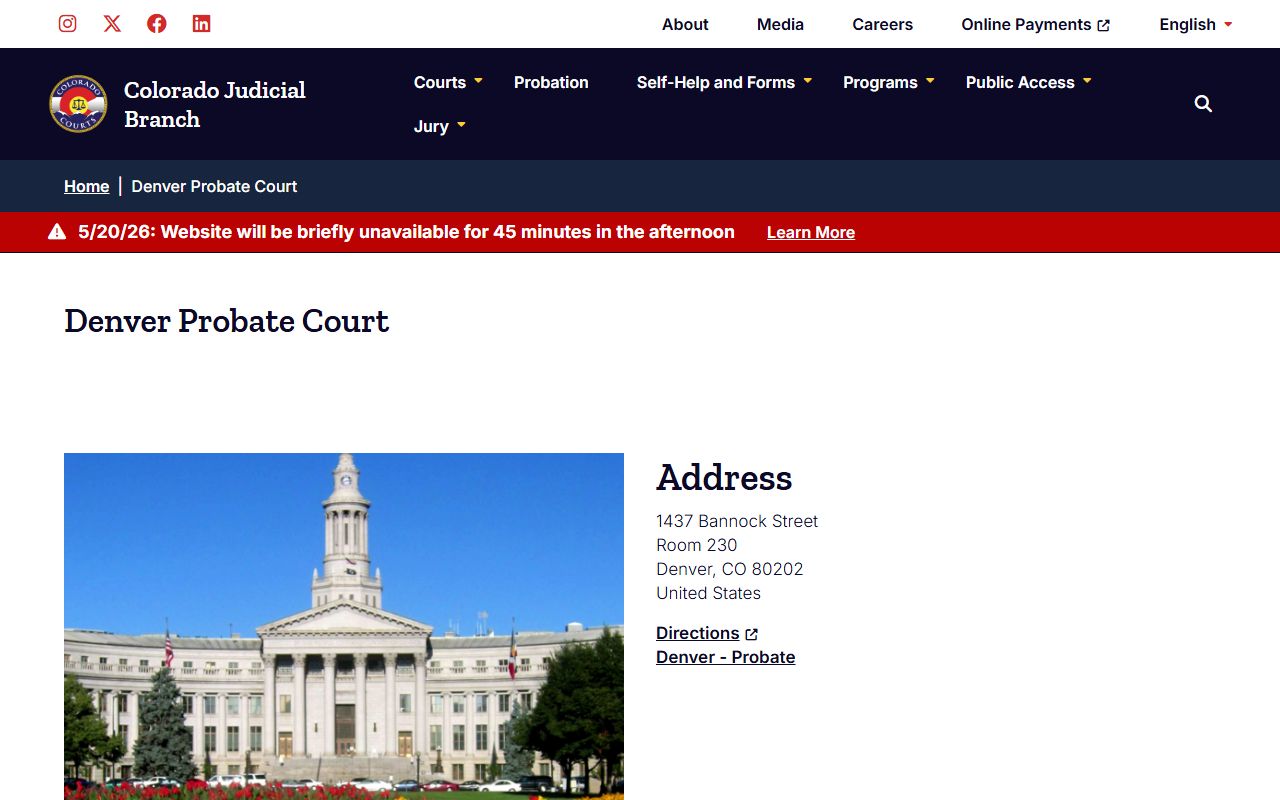 From the second-floor elevator at 1437 Bannock, turn left, and the clerk's office is at the end of the hall on the right. The self-help office is around the corner. The clerk's records email is DenverProbateRecordsRequest@judicial.state.co.us, and the phone line is 303-606-2303. The statewide probate index does not go further back than 1988, so pre-1988 records held outside Denver should be requested from the originating county.
- Testator
- A person who makes a valid will directing how their property passes at death.
- Executor
- The personal representative named in a will to manage the estate, pay debts, and distribute assets.
- Conservator
- A court-appointed manager of the financial affairs of a minor or an adult who cannot manage their own property.
- Guardian
- A court-appointed person responsible for the personal care and major decisions of a ward.
- Letters
- Court document that gives a personal representative, guardian, or conservator legal authority to act.
Denver County Court Records Fees
Copy fees are the same across most Denver court counters. Denver County Court lists paper copies at $0.25 per page. Certified copies add $20 per document. The Colorado Judicial Branch fee schedule on the state record request form matches those numbers for parties' own cases, with parties and their attorneys capped at $15 for copies in their own case and no cap for nonparties. Name searches cost $5. Research and redaction work runs $30 per hour after the first hour, billed in 15-minute increments. A credit and debit card service fee of 2.5% started May 1, 2025 for Clerk and Recorder transactions.
| Item | Amount |
|---|---|
| Plain copy per page | $0.25 |
| Certified or exemplified copy | $20 per document |
| Name search | $5 |
| Research / redaction (after first hour) | $30 per hour, in 15-minute increments |
| Transcript of judgment | $25 |
| Certificate of satisfaction | $20 |
| Denver Probate offsite retrieval | $15 per case |
| Denver Probate postage | $1 per 10 pages |
| Marriage / civil union license | $30 |
How to Interpret Denver County Court Records
A Denver case file is easier to read once the case-number code makes sense. The four-digit year sits in front. The case class follows. CR is criminal. CV is civil. DR is domestic relations. JV is juvenile. JD is juvenile delinquency. PR is probate. T is traffic. S is small claims. M is misdemeanor or municipal in some contexts. CW is water court. R is a miscellaneous or restricted class. The state docket search uses those same letters to filter results. Denver County Court records also use GS, GV, and D class markers for County Court matters, called out in the state request form note.
The next thing to know is the difference between a charge and a conviction. A charge is an accusation filed by the prosecutor. A conviction is a guilty plea or a guilty verdict that the court has entered. A docket may show several charges, with some dismissed and others taken to plea. Disposition codes record the result for each count. Common values include guilty plea, jury verdict guilty, dismissed with prejudice, dismissed without prejudice, deferred judgment, and bond forfeiture. A sealed result still keeps the docket entry private from public view, even though the case once existed.
Bond and bail terms show up in both court and inmate records. Bond is the security or set of conditions for release. A bail amount is the dollar figure tied to that bond. A PR bond, or personal recognizance bond, is a promise to appear without cash. NBA means no bond allowed. A bench warrant is a warrant a judge issues, often for failure to appear, also tagged FTA. Surety bonds use a bondsperson as a third-party guarantor. The Denver inmate lookup shows the bail amount in the schedules array tied to each charge.
Accuracy and Record Limitations
Court systems lag in places. A clerk may need a day or two to add a new filing to the public docket. Sealed cases vanish from search results, even if the case once existed. Disposition fields can sit blank until the judge enters the final order. The County Court portal returns Sentence, Disposition, and ROA online for cases with valid case numbers, but case documents are not visible. Plan to call or visit the clerk if a docket entry seems incomplete or stale. For District, Probate, and Juvenile cases, the records counter at Room 256 of the City and County Building can confirm details by phone at 303-606-2300.
Errors do happen. Names get misspelled at intake. Dates get entered with the wrong year. Charges get reclassified after a plea. If a record looks wrong, the right place to ask for a correction is the originating clerk's office. Denver County Court asks that record requests come in writing by email, in person, or U.S. Mail to 1437 Bannock Street, Attention: Record Request, Denver, CO 80202. The data request email is coradatarequests@denvercountycourt.org. Telephone and social media are not accepted channels for record requests.
Note: Verify important details with the clerk's office before relying on an online record for legal or employment decisions.
History of Denver County Courts
Denver County Court traces its modern form to 1965. The Colorado Constitution, the Denver Charter, and the City and County of Denver structure together carved out a unique split that has held since. David Brofman, who had served as a Denver County Judge over probate matters since 1951, became the first Judge of the Denver Probate Court in 1965. The four separate trial courts have run side by side since: County, District, Probate, and Juvenile. The arrangement is unique among Colorado judicial districts. Every other district runs a combined court with shared clerks.
The courthouse footprint also took its shape over the same period. The City and County Building has anchored Civic Center since 1932 and still holds civil, domestic, traffic, and probate functions. The Lindsey-Flanigan Courthouse opened in 2010 and consolidated criminal divisions and juvenile court west of Civic Center Park. The Ralph L. Carr Judicial Center, completed in 2013, brought the Colorado Supreme Court and Court of Appeals to 2 East 14th Avenue. The downtown jail next to Lindsey-Flanigan, known as the Van Cise-Simonet Detention Center, opened in 2010 with the courthouse and remains the main intake site. The whole cluster makes Denver's court system unusually walkable. Visitors can finish a District filing at 1437 Bannock, walk to Lindsey-Flanigan for a criminal copy, and stop at the Clerk and Recorder at 200 West 14th in a single morning.
Frequently Asked Questions
How do I search Denver County Court records online?
Use the Denver County Court public portal at public.denvercountycourt.org if you have a valid case number or AB number. The portal returns disposition, sentence, and the register of actions for a known case. It does not let the public search by name or business and does not show case documents. For documents, contact the criminal or municipal clerk at Lindsey-Flanigan Room 160, or the traffic and civil clerk at the City and County Building Room 135. For District, Probate, and Juvenile cases, use the Colorado Judicial docket search and the state record request form.
How do I find someone in Denver jail?
Use the Denver Sheriff inmate search at denvergov.org/InmateSearch. The tool accepts a full or partial name, a booking number, or a CD number. A facility filter lets you select All, County Jail, or Downtown Detention Center. Results include last name, first name, age, sex, race, facility, booking status, CD number, and booking number. If you cannot find a person but believe they are in Denver custody, call the jail information line at 720-913-3600. More details sit on the inmate records page.
Where do I get a Denver marriage license?
The Denver Clerk and Recorder issues marriage and civil union licenses, not the courts. Complete the online application through the CountyFusion/Kofile portal first, then book an appointment. In-person services are by appointment only. The office is at 200 West 14th Avenue. The license fee is $30. Colorado does not require a blood test or waiting period, and witnesses are not required. Self-solemnization is allowed. The license must be signed in Colorado within 35 days and returned for recording within 63 days.
More on the Denver County Court Records FAQ page.